
Contract machining at Off Site Manufacturing is scoped as program management rather than transactional supply. One relationship covers sourcing, precision CNC machining, finishing and coating, sub-assembly, and JIT delivery, with MRP integration into the customer’s planning system and IATF 16949 documentation on every lot. The program is designed for purchasing and supply-chain organisations whose current supplier map has grown beyond what quarterly reviews can govern.
This page describes who the program applies to, how program-management contract machining differs from transactional contract machining, the operational scope OSM delivers inside the contract, the documented consolidation math, and what to verify before committing contract-scope work to any supplier.
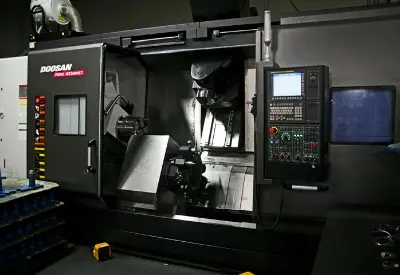
Program-management contract machining is relevant to specific roles in the purchasing and supply-chain function:
For the full market scope see OSM industries page. For OEM-level multi-year program framing, see OEM manufacturing services page.

A fragmented supplier base typically grows when each part, each process, and each finishing step is sourced to the supplier that bid lowest on that specific scope. Unit costs look optimised in the purchasing system, but the coordination function that ties those suppliers to the customer’s schedule lives inside the purchasing organisation itself.
Each supplier carries its own PPAP submission, audit cadence, freight lane, quality system, and failure modes. Consolidating that activity into a single program-management relationship is where the cost and overhead cases for contract machining typically originate.

Contract manufacturing sits on a spectrum. At one end is transactional supply: the buyer issues a PO for a quantity of parts, the supplier produces and ships, the relationship ends at the dock. At the other end is program-management supply, which published industry sources describe as a single partner handling procurement, production scheduling, inspection, finishing, and delivery, replacing a fragmented supplier base where the purchasing organisation runs the coordination function itself.

Three operational markers distinguish the two models:
Off Site Manufacturing is structured for the program-management end of that spectrum. OSM’s MRP system integrates with customer planning systems, so the production floor talks directly to the customer’s schedule. One partner handles sourcing, machining, finishing and coating, sub-assembly, and JIT delivery. IATF 16949 documentation travels with every lot and satisfies IATF, AS, and DoD audit requirements.

The OSM program covers the operational steps that typically live at different suppliers when contract machining is transactional:
The difference from transactional contract machining is scope, information flow, and where the coordination load sits. The scope is wider, the information flow is tighter, and the coordination load sits with the supplier rather than the customer.
Published industry literature on supply-chain consolidation identifies four specific levers that move when a fragmented supplier base becomes a program-management relationship:
The quantifiable benefits compound. JIT delivery combined with MRP integration has been documented to lower inventory cost, shorten lead times, tighten supplier-customer information flow, and reduce expediting frequency. Those are procurement overhead lines on the customer’s P&L.
The qualitative benefit shows up in status cadence: the program manager walks into the production meeting with shipment status already in the MRP link rather than needing a call to get it.
Certifications: IATF 16949 quality management system. Documentation satisfies IATF, AS, and DoD on every contract lot.
Program-management claims deserve program-management evidence. Off Site invites any purchasing or quality team evaluating OSM to verify the following of any supplier on the bid sheet:
The OSM industries page shows where programs already run. The pillar CNC machining services page frames the full capability envelope.
Transactional contract machining is purchase-order-driven: one PO, one shipment, the relationship ends at the dock. Program-management contract machining handles sourcing, machining, finishing, inspection, sub-assembly, and JIT delivery as a single ongoing relationship with control plans per part, APQP and PPAP discipline on new programs, and MRP integration to the customer planning system.
MRP integration connects the supplier’s production floor to the customer’s planning system so schedule information flows in both directions. Published industry sources document that MRP integration coupled with JIT delivery lowers inventory cost, shortens lead times, and reduces expediting frequency. The practical outcome is that status calls become exception traffic rather than default traffic.
Fewer freight lanes, elimination of duplicate PPAP and audit activity across redundant suppliers, reduction of expedite events because fewer hand-offs create fewer failure points, and avoidance of quality-escape costs at hand-off boundaries where nobody owns the full build.
Yes. OSM’s contract machining program covers sourcing, machining, finishing and coating, sub-assembly, and JIT delivery as a single program-management relationship, with IATF 16949 documentation traveling on every lot.
: Industry benchmarks place unplanned automotive-assembly downtime at roughly 22,000 dollars per minute, around 1.3 million dollars per hour, with severe cases up to 3 million per hour. OEM supplier quality manuals describe containment within 24 hours, final 8D within 10 working days, minimum 30-day quarantine, and PPM chargebacks assigned to the supplier identified as the cause. One line-stoppage event in a fragmented supply base typically exceeds a year of unit-price savings across that supplier.
Send the drawing set, the annual volume range, the PPAP level and IATF documentation requirements your OEM customer specifies, and any finishing, coating, or sub-assembly scope. Off Site’s team returns a scope
If you have a current supplier map that has become a source of friction, the fastest step is a direct conversation with Off Site’s team about what consolidation into a program-management relationship would actually look like. Send your drawing set and current volume; Off Site’s team will come back with a scope map, a PPAP and APQP path, and an MRP-integration plan before the first quote.
For teams whose programs already qualify for OEM-level program management, the adjacent OEM manufacturing services page frames the multi-year, multi-model program discipline.

Prismatic geometry, cross-axis features, pockets, and profiled surfaces on iron, steel, aluminum, and brass. Milling is the process that produces what turning cannot reach, with control-plan discipline around chatter, and tool deflection.
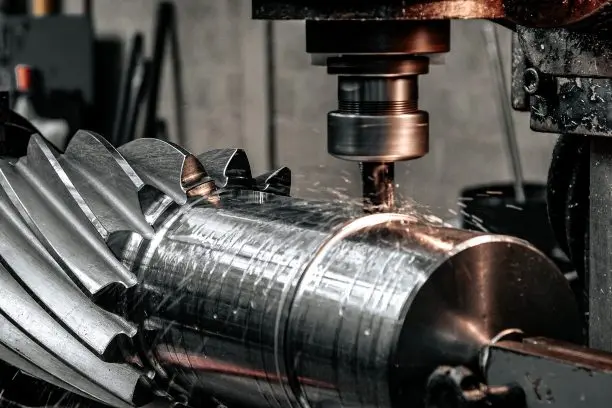
Cylindrical features, shafts, bushings, and journals on live-tool and multi-axis lathes. Turning is where OSM routinely holds concentricity and roundness better than 0.0005 in. TIR, with surface finishes in the Ra 0.8 to 3.2 micrometer band.

The tight-tolerance band, the thermal control, and the inspection cadence that hold plus or minus 0.0005 in. across a shift and across a program.

Holes and internal threads on platforms with genuine rigid-tapping capability. Where tap feed per revolution equals pitch and torque overload, chip packing, and synchronization error are actively managed rather than caught after the fact.
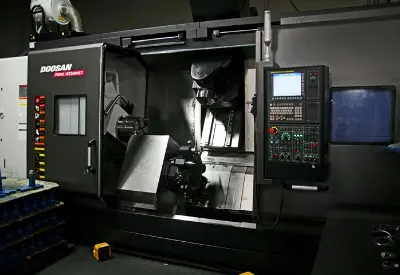
Program-management contract machining for OEMs and Tier 1 suppliers who need sourcing, machining, finishing, and JIT delivery handled as one relationship with MRP-grade information flow.
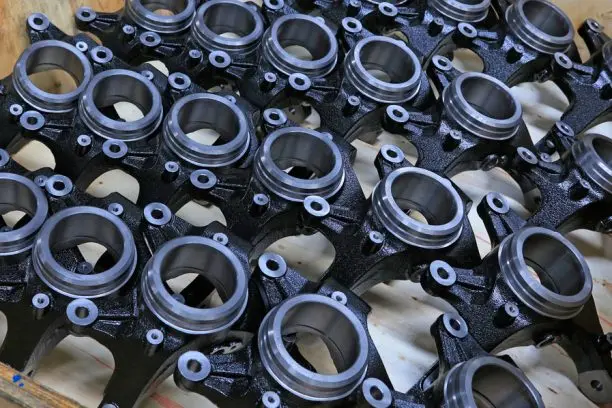
Multi-year OEM program support: APQP on new programs, PPAP against AIAG Levels 1 through 5, IATF documentation on every lot, and the program discipline that holds cost across model years.